

Everything Originates with a Belief
She was so angry at their first appointment that she wouldn’t even let me speak until she had read her detailed list of complaints. He didn’t help parent their teenager. He didn’t listen to her. They didn’t have enough time together. Bottom line: her unhappiness was his fault.
He admitted that he pretty much stayed clear of her. He wanted to please her, but didn’t know how. When he tried to parent, she took their son’s side against him. He walked on eggshells, afraid of triggering her anger.
Their first assignment was MODULE ONE of the Millionaire Marriage Club online course. The subtitle is Loving and Feeling Loved. The purpose of this module is to force unhappy couples to turn their attention away from what they think is wrong, and focus attention on three practices that are present in nearly every happy marriage.
Three Loving Habits
Couples that have been unhappy with each other for quite a while have a hard time adopting these new habits, but when forced to do so, it immediately shifts the energy between them from blame to something more positive…gratitude? remembering the good?
#1: Genuine Appreciation
The first assignment is to give your partner a genuine appreciation at least once per day. When asked to try this during a session with me, it sometimes takes several minutes for each to think of something they appreciate about the other. They must go to a different place in their brain to force remembrance of a kindness, or a chore they take for granted.
The most frequent complaint I hear from men and women is that they feel unappreciated. When an appreciation is given, the receiver’s job is to repeat it back. This forces them to receive the appreciation…to not dismiss it.
#2: Love Languages
Second, they go to 5lovelanguages.com. Each takes the simple quiz to identify the actions that give them the feeling of being loved. Words of Affirmation? Gifts? Quality Time Spent Together? Acts of Service? Physical Affection? Then they are to give love to their partner in their partner’s primary love language.
#3: Go on a Date
Third, go on a date…just the two of them. Do something they both enjoy. It may be a hike in the hills, or walk in the part, or playing a table game. It could be dinner and a movie. But, the purpose is to remember why they love each other.
Changing a Belief
Module One exercises challenge a couple’s belief that “everything is wrong and it’s all his/her fault.” Without the practice of effective communication skills and kind habits, their thoughts get stuck in a groove that turns out to be a lie. Everything is not wrong. When each sets aside their grievances for a short time, they remember that they sometimes like each other.
When the couple mentioned above followed these instructions, they came back the following week happy and hopeful. When she began being truthful without attacking him, she realized some of her unhappiness was due to her own choices.
When they read Pungent Boundaries, they began parenting as partners, not adversaries. When they learned to really listen to each other, they found common ground. He began sharing more when he wasn’t afraid of her anger. She began handling her anger with more self- and partner-respect.
The new belief they adopted together was, “We were unhappy because there were marriage skills we didn’t know. Now we use the skills we’re learning to create the happy, loving marriage we both want. We know how to remain happy with each other for the rest of our lives!”
Beliefs That Create Relationship Problems
- He/she should know what I need and give it to me without my asking.
- He/she doesn’t make me feel loved, therefore he/she doesn’t love me.
- He/she doesn’t listen to me, so I’ve quit sharing my hopes, dreams, and desires.
- The only way to be happy is to get a divorce and start over.
- I’ll be happier alone than I am with him/her.
- I’ve tried everything. Nothing works.
- He/she is the one who needs to change if this marriage is ever going to work.
- Forgiveness is impossible.
- I’ll only respect him/her when he/she treats me with respect.
The Most Difficult Truth to Believe
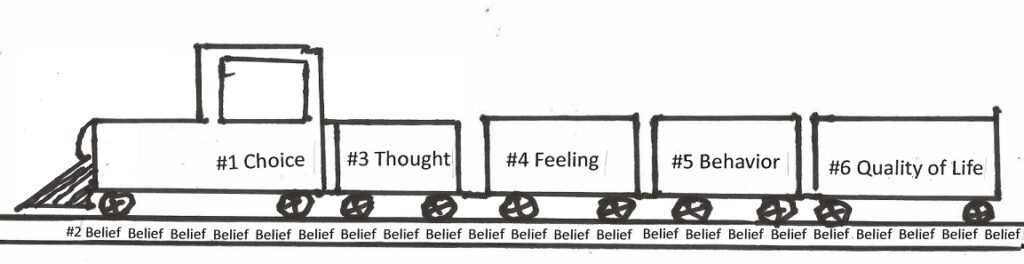
We unconsciously adopt communication, behavior, and belief patterns from our experiences as children before the age of five. At that young age, we may not even have language to define the belief we are adopting. We definitely don’t have the critical thinking skills or experiences to evaluate whether or not that belief is always true or only sometimes true with some people.
The most damaging beliefs are those that we adopt about ourselves…our value, our goodness, our intelligence, abilites and gifts. For example, “I am unlovable,” or, “I never do anything right,” or “I can’t depend on anyone but myself.”
The beliefs adopted as children determine the quality of relationships we will attract and create. Notice in this illustration, there is no one driving the train. Most adults have never critically examined their beliefs in light of the current qualities in their lives.
The belief that is hardest to consciously adopt is that our quality of life (what we don’t like about our life) is not the fault of a partner, a child, the boss, the government or culture. At the deepest level, our beliefs are the source of what we are experiencing, whether happy, or unhappy. To choose the belief that at some mysterious, spiritual level, I chose the life I am living, requires courage and willingness to live with authentic power…the power to change the outcome by changing myself.
Relationship Law #5: Choose Empowering Beliefs
“I can improve the quality of my relationships and life by choosing more empowering beliefs.” When we choose this empowering belief, the Universe conspires to bring us the teacher, mentor, book, or inspired thought to guide us on this hero’s journey. Situations or relationships that seemed impossible amazingly change. Opportunities show up that we couldn’t even imagine before. Solutions to sticky problems emerge with ease. Love is rekindled. Passion renewed.
You have my love and support,
